


Wilderness navigation skills are essential for anyone who ventures into the great outdoors, whether for a weekend hike or an extended backcountry expedition. Understanding how to navigate effectively can mean the difference between a rewarding adventure and a potentially dangerous situation. With the increasing popularity of outdoor activities, it is crucial for both novice and experienced adventurers to hone their navigation skills.
The ability to read a map, use a compass, and understand the terrain can enhance safety and enjoyment while exploring nature. Moreover, wilderness navigation fosters a deeper connection with the environment. When individuals learn to navigate using natural landmarks, topographical features, and celestial bodies, they develop a greater appreciation for the landscapes they traverse.
This knowledge not only enriches the outdoor experience but also instills confidence in one’s ability to explore remote areas. As outdoor enthusiasts become more self-reliant, they are better equipped to handle unexpected challenges that may arise during their adventures.
Key Takeaways
- Wilderness navigation skills are crucial for outdoor enthusiasts to safely and confidently explore remote areas.
- Understanding the basics of map and compass navigation is essential for successful wilderness navigation.
- Mastering map reading techniques is important for interpreting topographic maps and understanding terrain features.
- Navigating with a compass requires essential skills such as taking bearings, orienting the map, and following a chosen direction.
- Using map and compass together allows for advanced techniques such as triangulation and resection to achieve precision navigation in the wilderness.
Understanding the Basics of Map and Compass Navigation
Choosing the Right Map
For beginners, it is advisable to start with a simple map that highlights major landmarks and trails before progressing to more complex topographic maps.
The Importance of a Compass
The compass serves as an indispensable tool in wilderness navigation. It allows adventurers to determine their direction relative to magnetic north, which is vital for orienting a map.
Mastering Compass Skills
Understanding how to read a compass involves knowing how to identify the cardinal directions—north, south, east, and west—as well as how to take bearings. For those new to navigation, practicing with a compass in familiar surroundings can build confidence before venturing into more challenging environments.
Mastering Map Reading Techniques for Wilderness Navigation
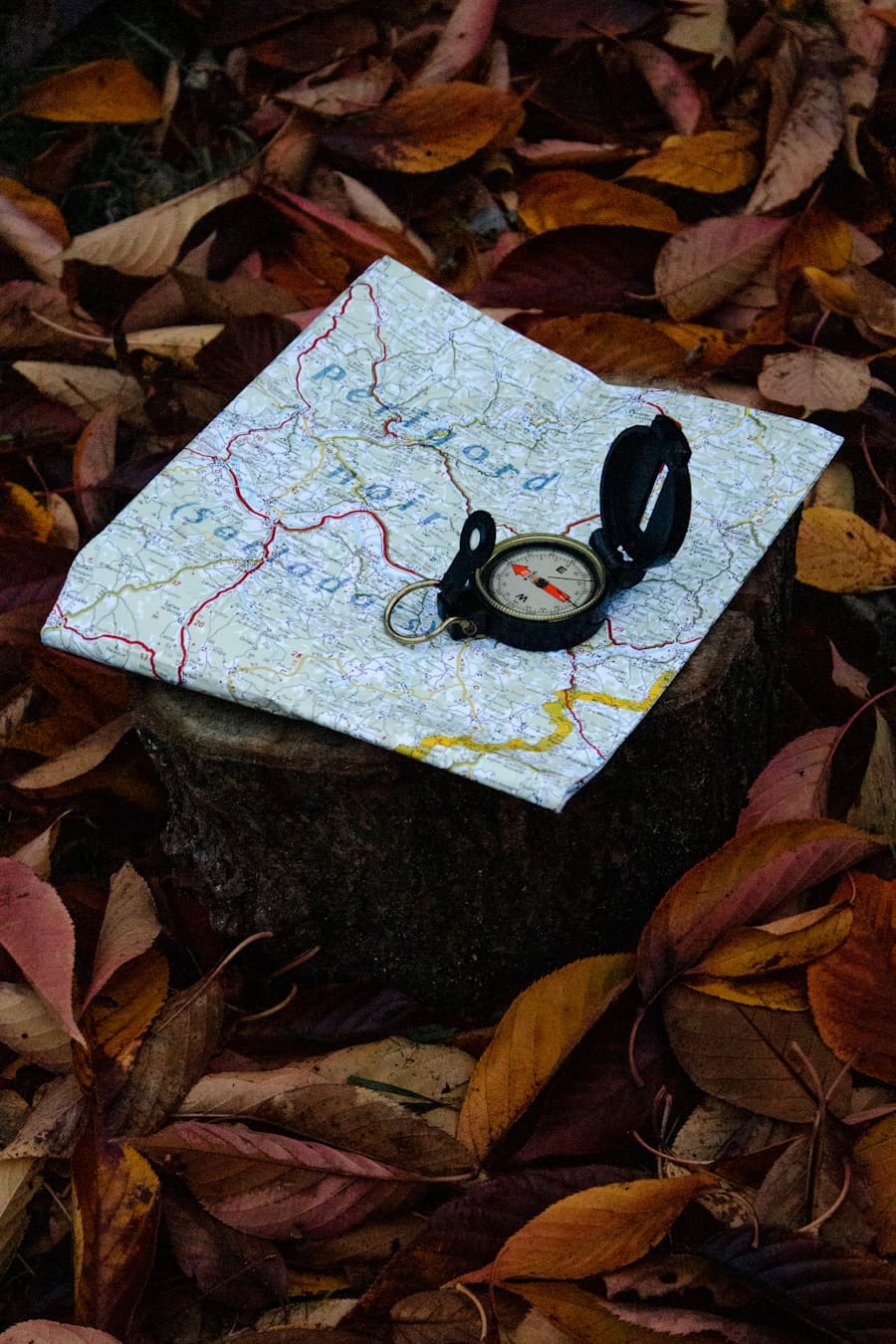
Mastering map reading techniques is a critical component of effective wilderness navigation. One of the first skills to develop is understanding contour lines, which indicate elevation changes on a topographic map. By learning to interpret these lines, navigators can visualize the terrain and anticipate challenges such as steep climbs or valleys.
Additionally, recognizing landmarks such as rivers, lakes, and peaks can help in orienting oneself within the landscape. Another important technique is triangulation, which involves using two or more known points on a map to determine one’s location. By taking bearings from these points with a compass and plotting them on the map, navigators can pinpoint their exact position.
This method is particularly useful in dense forests or unfamiliar areas where visibility may be limited. For advanced navigators, incorporating GPS technology can enhance accuracy, but it is essential to maintain traditional skills as a backup.
Navigating with a Compass: Essential Skills for Wilderness Exploration
Navigating with a compass requires practice and familiarity with its components. A standard compass consists of a magnetic needle, a rotating bezel, and a baseplate with measurement markings. To effectively use a compass, one must learn how to take a bearing by aligning the compass with the desired direction and adjusting for declination—the difference between magnetic north and true north.
In addition to taking bearings, understanding how to follow a bearing is crucial for successful navigation. This involves setting the compass to the desired bearing and then visually identifying landmarks in that direction. For beginners, it is helpful to practice this skill in open areas where visibility is clear before attempting it in more challenging terrains.
Advanced navigators may also employ techniques such as pacing—counting steps to estimate distance traveled—enhancing their ability to navigate accurately over long distances.
Using Map and Compass Together: Advanced Techniques for Precision Navigation
Combining map and compass skills allows for precision navigation in wilderness settings. One advanced technique is known as “bearing and distance,” which involves taking a bearing from the map and then using pacing or timing to estimate distance traveled along that bearing. This method is particularly useful when navigating through dense forests or areas with limited visibility.
Another effective technique is “resection,” which allows navigators to determine their location by taking bearings from two or more visible landmarks on the map. By plotting these bearings on the map, one can triangulate their position accurately. This skill is invaluable in situations where GPS devices may fail or when navigating in areas without reliable cell service.
Mastering these advanced techniques not only enhances navigation skills but also builds confidence in one’s ability to explore remote wilderness areas.
Navigating in Challenging Terrain: Tips and Tricks for Wilderness Navigation
Breaking Down the Journey
One strategy is to break down the journey into smaller, manageable segments, focusing on reaching visible landmarks rather than attempting to navigate long distances at once.
Utilizing Natural Features
Additionally, utilizing natural features such as rivers or ridgelines can aid in navigation. These features often serve as reliable reference points that can guide adventurers through difficult terrain.
Understanding Elevation and Weather Patterns
For those venturing into mountainous areas, understanding how elevation changes affect weather patterns is also crucial for safety and planning.
Building Confidence in Wilderness Navigation: Practice and Preparation
Building confidence in wilderness navigation requires consistent practice and thorough preparation. Beginners should start by familiarizing themselves with maps and compasses in familiar environments before tackling more complex terrains. Joining local hiking groups or taking navigation courses can provide valuable hands-on experience while learning from seasoned navigators.
Preparation also involves understanding one’s limitations and planning routes accordingly. Before heading out, it is essential to study maps, check weather conditions, and inform others of your plans. Carrying essential gear such as extra food, water, and navigation tools ensures that adventurers are well-equipped for unexpected challenges.
The Importance of Continual Learning and Improvement in Wilderness Navigation Skills
Wilderness navigation is not a skill that can be mastered overnight; it requires continual learning and improvement. As outdoor enthusiasts gain experience, they should seek opportunities to refine their skills through workshops, online courses, or mentorship from experienced navigators. Engaging with the outdoor community can provide valuable insights and tips that enhance one’s navigation abilities.
Moreover, staying updated on advancements in navigation technology can complement traditional skills. While GPS devices offer convenience, understanding how to navigate without them remains essential for safety in remote areas. By committing to lifelong learning in wilderness navigation, adventurers can ensure they are prepared for any journey into the wild.
In conclusion, wilderness navigation skills are vital for anyone who seeks adventure in nature’s vast landscapes. By mastering map reading techniques, compass usage, and advanced navigation strategies, outdoor enthusiasts can enhance their safety and enjoyment while exploring remote areas. Whether you are a beginner or an experienced navigator, continual practice and learning will build confidence and ensure you are well-prepared for your next wilderness adventure.
Engage with fellow outdoor lovers by sharing your experiences or seeking advice on navigation techniques—every journey into the wild offers an opportunity for growth and discovery. **Image Placement Suggestions:**
1. **Image of a topographic map** – Alt text: “Topographic map showing contour lines and landmarks.”
2.
**Image of a compass in use** – Alt text: “Hiker using a compass for navigation in the wilderness.”
3. **Image of hikers navigating challenging terrain** – Alt text: “Group of hikers navigating rocky terrain using maps.”
4. **Image of a workshop on wilderness navigation** – Alt text: “Participants learning wilderness navigation skills in an outdoor workshop.”
FAQs
What is wilderness navigation?
Wilderness navigation is the process of using tools such as maps and compasses to determine one’s location and navigate through natural, outdoor environments.
Why is it important to master the map and compass for wilderness navigation?
Mastering the map and compass is important for wilderness navigation because it provides a reliable and accurate method for determining direction and location, especially in areas where GPS or other electronic devices may not be reliable.
What are the basic skills needed for wilderness navigation using a map and compass?
Basic skills for wilderness navigation using a map and compass include understanding how to read a topographic map, using a compass to determine direction, and understanding how to orient the map to the surrounding landscape.
What are the benefits of using a map and compass for wilderness navigation over GPS or electronic devices?
Using a map and compass for wilderness navigation provides a reliable method that does not rely on batteries or satellite signals. It also allows for a deeper understanding of the surrounding landscape and terrain.
What are some common mistakes to avoid when using a map and compass for wilderness navigation?
Common mistakes to avoid when using a map and compass for wilderness navigation include failing to account for declination, not keeping the map and compass protected from the elements, and not regularly checking one’s position on the map.
What are some resources for learning how to master the map and compass for wilderness navigation?
Resources for learning how to master the map and compass for wilderness navigation include books, online tutorials, and outdoor navigation courses offered by outdoor education organizations.