

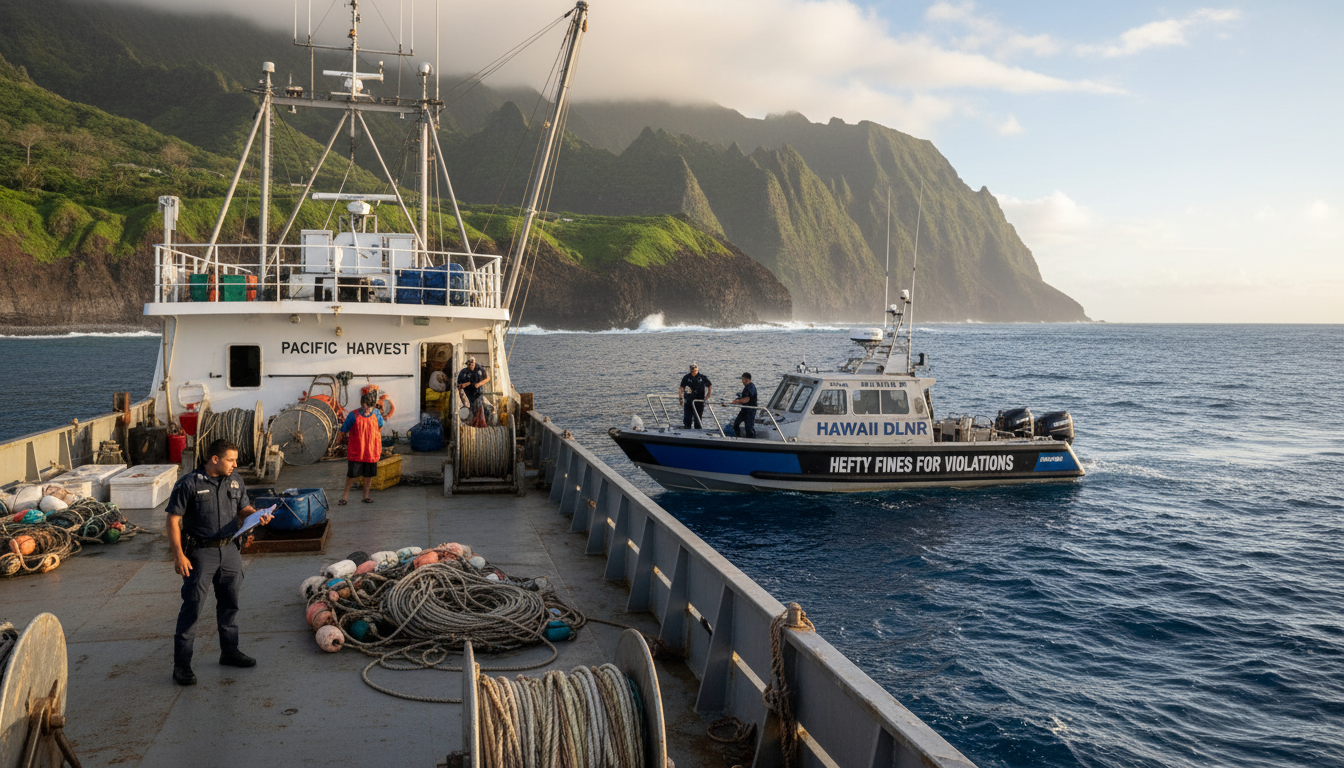

Maximum Administrative Penalties Imposed for Longline Fishing Violation
Hawaii’s Fisheries at Risk: A One-Year License Revocation and Over $10,000 in Fines
HONOLULU – The waters surrounding Hawaii are once again facing a significant threat due to illegal longline fishing activities. Konane Zager, captain of the fishing vessel Waiʻaka, has been hit with a hefty fine totaling $10,051.90 following a serious violation of longline fishing regulations last May. Additionally, his Commercial Marine License has been revoked for a year, underscoring the state’s commitment to conserving its marine ecosystems.
On May 7, 2025, officers from the Division of Conservation and Resources Enforcement (DOCARE) spotted Zager’s vessel operating off the Kona coast, where he had deployed longline gear extending an astonishing 3.69 nautical miles—over three times the legal limit—in waters where such methods are strictly forbidden. During the retrieval of his gear, officers documented three yellowfin tuna; two were subsequently sold to a local buyer, while the third was released alive back into the ocean. Zager openly acknowledged deploying the gear and admitted that he was aware it exceeded the one-nautical-mile limitation.
Upon completing its investigation, DOCARE recommended imposing the maximum penalties prescribed under Hawaii law, which the Board of Land and Natural Resources (BLNR) unanimously approved, including:
- $1,000 for the first offense of longline fishing in state waters
- $3,000 for the take of three ahi (yellowfin tuna), calculated at $1,000 per fish taken or injured
- $6,051.90 for administrative costs associated with the enforcement and investigation
The penalties serve as a stern reminder that illegal fishing practices jeopardize Hawaii’s rich maritime diversity. The collected fees will be deposited into the Commercial Fisheries Special Fund, which supports sustainable management and conservation initiatives aimed at safeguarding Hawaii’s aquatic resources.
“Today’s decision sends a resounding message: illegal longline fishing in Hawaii’s waters will not be tolerated,” stated DLNR Acting Chair Ryan K.P. Kanakaʻole. “Our fisheries laws are designed to protect our marine resources and ensure sustainable fishing practices. We must be vigilant in enforcing these regulations.”
Brian Neilson, Administrator of the Division of Aquatic Resources, echoed this sentiment, reinforcing the necessity of prohibitive measures in local waters to preserve traditional fishing grounds. “The board’s decision reflects the severity of this violation and our commitment to uphold protective measures for our fisheries,” Neilson added.
Notably, the BLNR directed the Division of Aquatic Resources to forward all investigative documents to the National Oceanic and Atmospheric Administration’s Office of Law Enforcement for potential federal law violations, indicating that the ripple effects of this case may extend well beyond state jurisdiction.
Why It Matters
The impact of illegal longline fishing on Hawaii’s aquatic ecosystems cannot be overstated. These practices threaten not only individual species but also disrupt entire food webs, jeopardizing the delicate balance necessary for sustainable local fisheries and the livelihoods relying on them. As conservationists, anglers, and the community at large advocate for responsible fishing, the enforcement of stringent penalties acts as a foundation for protecting Hawaii’s unique marine assets in the long run.
Field Insights
Pro-Tips for Responsible Fishing in Hawaii:
- Know the Regulations: Familiarize yourself with local fishing laws and restrictions to avoid penalties.
- Sustainable Practices: Opt for fishing methods that minimize bycatch and adhere to designated fishing areas.
- Reporting Violations: Remain vigilant and report any illegal fishing activities to local authorities to protect marine ecosystems.
- Contribute to Conservation: Engage with local conservation efforts to help preserve the natural integrity of Hawaii’s waters.
By staying informed and abiding by the laws designed to protect Hawaii’s vibrant marine life, the community can ensure a rich and sustainable fishing heritage for generations to come.
For additional information or media inquiries, please contact:
Patti Jette
Communications Specialist
Hawai‘i Dept. of Land and Natural Resources
Email: [email@example.com]
For images of the Waiʻaka fishing vessel taken during the enforcement operation, visit: Download Photographs
This news article intends to shed light on critical conservation issues while engaging readers with practical insights and information on protecting the lush aquatic ecosystems critical to Hawaii’s identity.